 Espaço daPlásticaHospital · Campo Grande
Espaço daPlásticaHospital · Campo Grande
Espaço daPlásticaHospital · Campo Grande
Hair · Surgical procedure
A hair transplant restores hair in areas of baldness or thinning by transferring follicles from denser donor regions to the affected areas. In the FUE technique, follicular units are extracted individually, without removing a strip of scalp. It is indicated for men and women, after the cause of hair loss has been investigated.
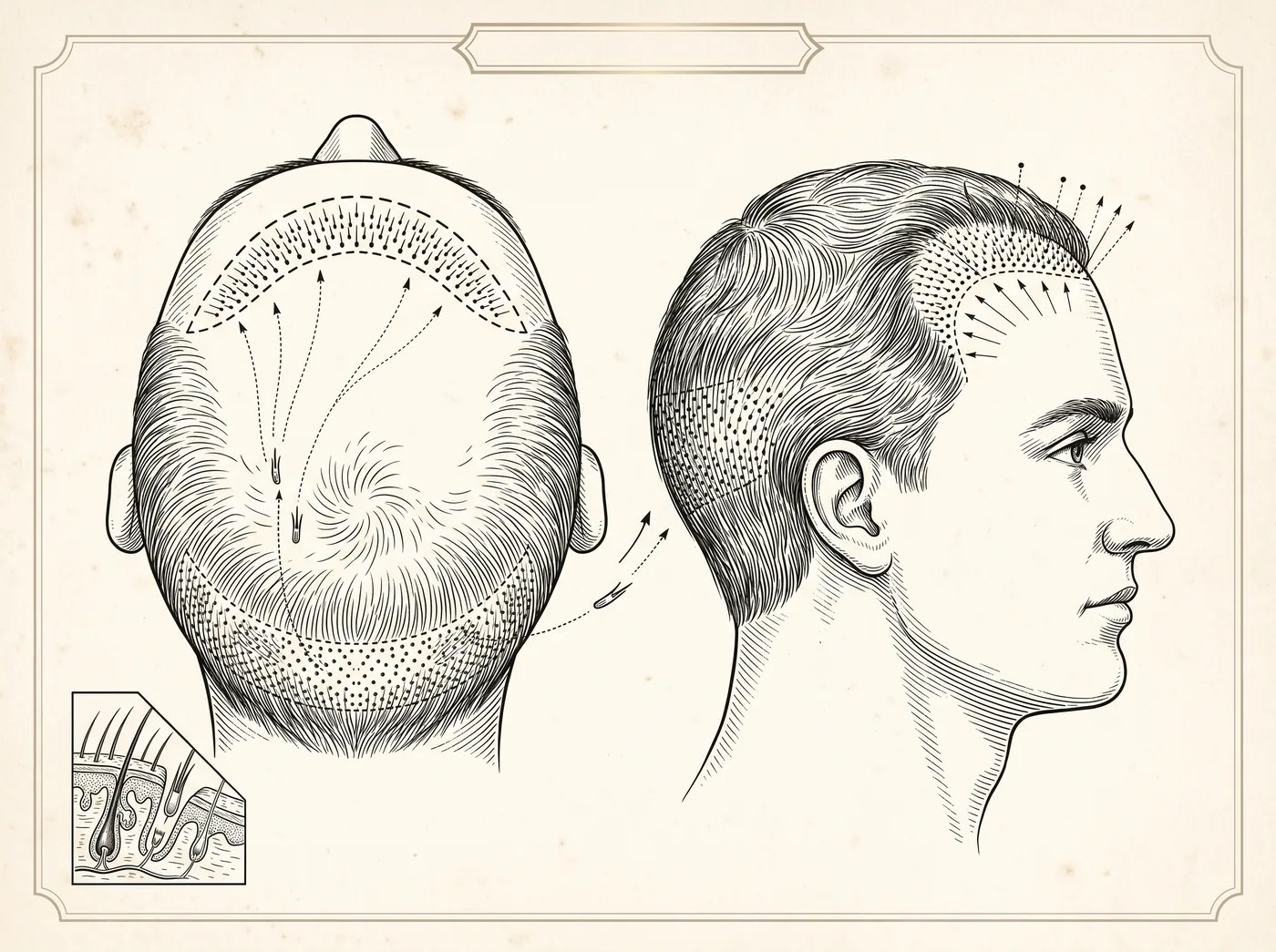
Goals of the procedure
Every surgical procedure involves risks. An individual evaluation with a plastic surgeon is essential to determine the appropriate treatment for each case.
Understanding the procedure
In follicular unit extraction (FUE), the transplant is organized around the hair's natural groupings — the follicular units — which are harvested individually from a donor area, usually at the back and sides of the head, where follicles tend to be more resistant to the hormonal action that causes pattern hair loss. These units are preserved and then implanted in the area being treated, respecting the natural angle, direction, and distribution of the hair. Since no strip of scalp is removed, there is no linear incision in the donor area.
A transplant is meticulous work, in which planning the new hairline, the direction of the hairs, and their distribution weighs as much as the extraction and implantation themselves. The number of follicular units and the number of sessions vary according to the extent of the area, the characteristics of the scalp, and each person's goals. These details, along with the step-by-step process and the care required at each stage, are defined during the medical evaluation, case by case.
In addition to hair transplants, Hospital Espaço da Plástica performs the eyebrow transplant, a procedure frequently sought by women. Thinning or loss of eyebrow hair can have several origins — repeated plucking over the years, conditions that affect the hair, hormonal changes, trauma, or scarring — and not every situation calls for surgery. As with the scalp, the technique starts from follicular units harvested from the patient's own body, usually from the back of the head, prepared as single-hair grafts, which are better suited to the delicacy of the eyebrow.
The difference lies in the refinement: each follicle is implanted at a very flat angle to the skin and in the direction specific to each segment of the eyebrow, which changes from the head to the arch and the tail. Density is built gradually, with the goal of following the natural design of the region — softer at the start and slightly fuller through the body. Because the hairs originate from the scalp, they keep the growth pattern of their area of origin and tend to grow longer than a typical eyebrow hair, which usually requires periodic trimming. The intended design, this upkeep, and what the technique can or cannot offer in each situation are defined during the individual evaluation.
In hair transplantation, the most common cause of hair loss in men is androgenetic pattern baldness, which usually appears as a receding hairline and thinning at the top or the crown — the reason this procedure is more often sought by men. Even so, women can also be candidates for a hair transplant in specific situations, always after the origin of the hair loss has been investigated. A hair transplant tends to be considered when the loss is stabilized or under clinical control, when there is an adequate donor area, and when expectations are aligned with what the evaluation indicates.
The eyebrow transplant, in turn, is more often sought by women, frequently in connection with thinning caused by excessive plucking over time, but it is also an option considered for men. In both cases, age, history, degree of thinning, quality of the donor area, and overall health are part of the analysis. There is no single indication that fits every case: only the individual evaluation with the plastic surgeon determines whether the procedure is appropriate and which approach is most suitable for each person.
Both hair and eyebrow transplants are usually outpatient procedures. In the first days, care of the operated area is guided by the team, and mild local reactions — tenderness, slight swelling, or small crusts in the treated region and the donor area — may occur and tend to be temporary. It is also common for some of the transplanted hairs to shed in the first weeks: this phase is expected and precedes the growth, which occurs gradually over the following months. Physical exertion, sun exposure, and certain everyday habits generally call for caution during this period, following the guidance received.
Timelines vary from person to person and should be confirmed with the surgeon, according to each case. Follow-up visits make it possible to monitor progress and answer questions throughout the process. It is worth reinforcing that every procedure involves risks and that no result can be anticipated or guaranteed, since the body's response is always individual.
Because they are surgical procedures, hair and eyebrow transplants benefit from being performed in a facility prepared for them. At Hospital Espaço da Plástica, dedicated exclusively to plastic surgery, procedures rely on an in-house operating room, an in-house team, and the support of a hospital environment — aseptic conditions, monitoring, and backup in case any complication needs to be managed.
The choice of setting and team is part of the safety of any surgery and should be considered together with the medical evaluation. No facility eliminates the risks inherent in a surgical procedure, but a dedicated environment makes it possible to follow every stage, from preparation to the initial recovery. The individual consultation with the plastic surgeon remains essential to clarify indications, care, and alternatives for each patient.
Frequently asked questions
The transplanted hairs shed in the first few weeks — which is expected — and gradually grow back. Progress is usually noticed over the course of several months, with medical follow-up.
Follicles from the donor area tend to be more resistant to hormone-pattern hair loss. Even so, the progression of baldness in the other areas should be monitored and, in many cases, treated clinically.
It is performed under local anesthesia. After surgery, any discomfort is usually controlled with the prescribed medication.
No. An adequate donor area is required, and the cause of hair loss must be investigated — some causes call for clinical treatment before the transplant, or instead of it.
The next step
The right decision begins with a good conversation. Bring your questions: an individual evaluation is the first step of any plan.


