 Espaço daPlásticaHospital · Campo Grande
Espaço daPlásticaHospital · Campo Grande
Espaço daPlásticaHospital · Campo Grande
Body · Surgical procedure
Liposculpture reshapes specific areas of the body: it removes localized excess fat and can transfer it to areas that call for volume, such as the buttocks. It is a contour-refinement procedure — not a weight-loss method.
Goals of the procedure
Every surgical procedure involves risks. An individual evaluation with a plastic surgeon is essential to determine the appropriate treatment for each case.
Understanding the procedure
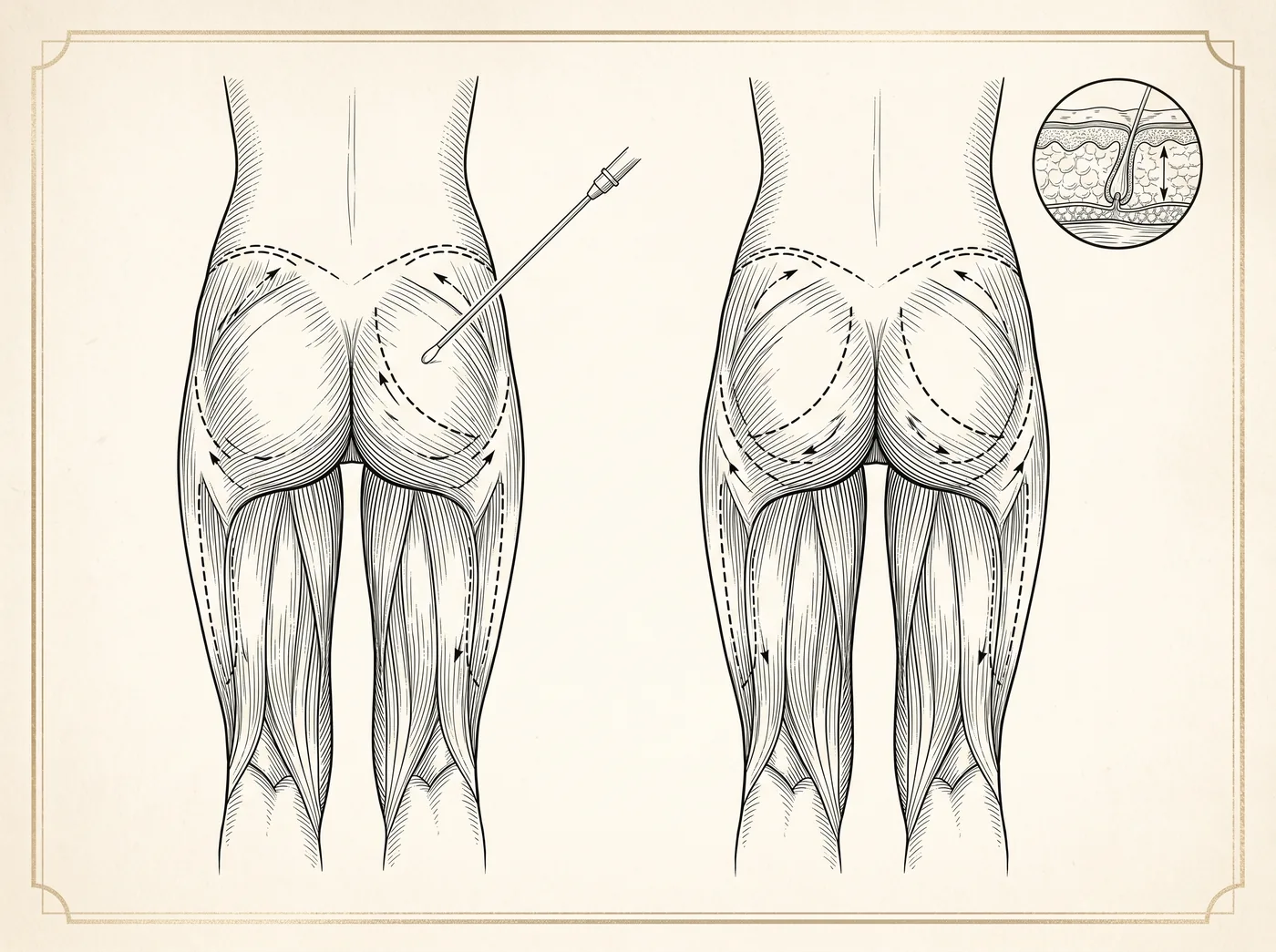
Liposculpture combines the suction of localized fat with the refinement of body contour. In the high-definition (HD) approach, the surgeon works the fat in different planes — from the deepest to the most superficial and in the spaces between muscle groups — with the goal of bringing out the natural definition of the musculature that already exists beneath the skin. Rather than simply reducing volume, the proposal is to respect and highlight the anatomy of each region, emphasizing the body's own transitions and contours. The planes addressed and what applies to each person are defined case by case, according to the anatomy and the goals discussed during the evaluation.
There is no single technique: the approach, the resources used, and the extent of the procedure vary according to the surgeon and the indication. The technical details and what makes sense for your case should be clarified during the consultation. Like every surgical procedure, liposculpture involves risks, and progress depends on each patient's individual factors.
Part of the fat suctioned during liposculpture can, when the surgeon deems it indicated, be processed and reused in the same patient — a resource known as autologous fat grafting. At Hospital Espaço da Plástica, one of the proposals of the high-definition approach is to graft this prepared fat also into the muscular plane of certain regions, with the goal of accentuating volume and definition and thus reinforcing the intended contour. The medical literature describes this fat transfer technique for muscle groups such as the pectorals, the muscles of the arms, and the calves, among others. The indication, the extent, and the regions treated are always individual and defined during the evaluation.
It is important to clarify that this is a technical proposal, not a guaranteed result: each body integrates the grafted fat in its own way, and part of the volume may be reabsorbed over time. Because it involves depositing fat in deeper planes, this approach requires detailed anatomical knowledge and specific criteria, topics the surgeon explains during planning. Determining whether grafting in the muscular plane is appropriate for your case — and in which regions — depends on the individual evaluation.
In general, liposculpture is considered for people with a stable weight and localized fat resistant to diet and exercise — not as a weight-loss method. Good overall health, the absence of conditions that would contraindicate surgery, and realistic expectations are points analyzed before any indication. Skin quality and elasticity, as well as the muscle tone of each region, also usually factor into this evaluation, especially when the goal is to bring out contour.
The indication — whether it exists, which areas to treat, and which approach to adopt — can only be defined in an individual evaluation with the plastic surgeon. Each body responds differently, and what is appropriate for one person may not be for another. That is why the in-person consultation is the essential step before any decision.
Recovery is progressive and varies from person to person, according to the extent of the procedure and each body's response. In the first days, swelling, tenderness in the treated regions, and the need for relative rest are common, with a gradual return to activities and, frequently, the use of a compression garment as directed. Postoperative follow-up and the team's guidance are part of this process and help steer each phase, whose timelines are individualized and confirmed with the surgeon.
Like every surgical procedure, liposculpture involves risks, which should be explained before the decision — among them, prolonged swelling, bruising, temporary changes in sensation, asymmetries, fluid buildup, contour irregularities, and, in less common situations, infection. Fat grafting in the muscular plane adds considerations of its own: it requires anatomical knowledge of the region, careful technique, and, depending on the area treated, additional precautions, since safety varies according to the site. For this reason, the risks, alternatives, and particularities of each region are part of the conversation with the surgeon, and the individual evaluation is essential to determine whether and how the procedure can be performed.
Performing liposculpture in a hospital devoted to plastic surgery means having an in-house operating room, an in-house team, and facilities designed for this type of procedure. The presence of an anesthesia team, monitoring, and a prepared hospital environment are factors that contribute to the safety of the operation. Admission and the immediate postoperative period take place within this same facility, with the team integrated at every stage.
No facility eliminates the risks inherent in a surgical procedure, but a dedicated hospital environment makes it possible to monitor the patient continuously, from preparation to the initial recovery. The individual evaluation remains the essential step in determining whether, how, and where the procedure can be safely performed in each case.
Frequently asked questions
Liposuction removes localized fat; liposculpture adds the possibility of grafting that fat into other areas, sculpting the body's contour as a whole.
No. The procedure addresses contour and localized fat — it does not replace diet, exercise, or weight-loss treatments. Ideally, your weight should be stable.
The removed cells do not return, but the remaining ones can increase in volume with weight gain. Healthy habits help maintain the contour achieved.
They depend on the extent of the procedure and the pre-anesthetic evaluation. The approach is defined by the surgeon together with the anesthesia team.
Generally, yes. Wearing a compression garment and lymphatic drainage massage are usually part of the post-operative instructions, as prescribed by the surgeon.
The next step
The right decision begins with a good conversation. Bring your questions: an individual evaluation is the first step of any plan.


